
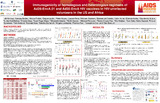
Immunogenicity of Homologous and Heterologous Regimens of Ad26-Enva.01 and Ad35-Enva HIV Vaccines in HIV- Uninfected Volunteers in the U.S. and Africa
Abstract
Background:
Heterologous prime boost vaccine regimens offer a
promising approach to improving T cell and antibody responses.
Homologous and heterologous prime boost regimens were
compared using two low seroprevalence Adenovirus vectors
expressing two HIV-1 subtype A Envs.
Methods:
Ad26.EnvA.01 and/or Ad35-EnvA were administered
at 5
·
10 10 viral particles intramuscularly in 217 volunteers (173
vaccine: 44 placebo) in three regions (US, East and South Africa)
with two different intervals. US volunteers (Groups A-D) re-
ceived heterologous (Ad26.EnvA.01
+
Ad35-EnvA or Ad35-
EnvA
+
Ad26.EnvA.01) regimens at 0/3- or 0/6-month intervals.
African volunteers (Groups E-L) received the same heterologous
regimens or homologous regimens consisting of two Ad26-
EnvA.01 or two Ad35-EnvA at 0/3 months.
Results:
Vaccine regimens were well tolerated. IFN-gamma
ELISPOT responses were detected in 44–100% of subjects (A-D),
6–62% (E-L) at 2 weeks and 78–100% (A-D), 47–88% (E-L) at 4
weeks after second vaccination for Ad26.EnvA.01 matched pep-
tide pools and 11–75% (A-D), 0–69% (E-L) at 2 weeks and 33–
100% (A-D) and 0–87% (E-L) at 4 weeks for Ad35-Env A matched
peptide pools. Env-specific CD4 and CD8 response rates were up
to 70% (CD4) and 80% (CD8) for IFN-gamma and/or IL2 ex-
pressing T-cells in Groups I-L (South Africa) at 4 weeks post
second vaccination. T-cell response magnitudes by ELISPOT and
flow cytometry were modest; differences between heterologous
or homologous regimens were dependent on peptide sets. Env
antibody responses were 93–100% in all groups with
>
10-fold
boost in magnitude at 4 weeks post second vaccination. Baseline
and vaccine-elicited Ad26 and Ad35 neutralizing antibodies were
observed with marked regional differences; East Africa
>
South
Africa
>
US and Ad26
>
Ad35 titers.
Conclusion:
Env antibody and T-cell responses were detected in
all groups and no correlation was detected between baseline
vector-specific neutralizing antibodies and Env-specific humoral
or cellular immune responses across all regions. Immunogenicity
in heterologous and homologous regimens was comparable.
Citation
Mutua,G.,2013.Immunogenicity of Homologous and Heterologous Regimens of Ad26-Enva.01 and Ad35-Enva HIV Vaccines in HIV- Uninfected Volunteers in the U.S. and Africa.Publisher
University of Nairobi
Collections
- Faculty of Health Sciences (FHS) [10418]